Price list
| Campervan consulting | €90/h |
| Tiny house consulting | €90/h |
| Business and start-up consulting | individually on request |
| Initial consultation | 30 min, donation-based |
| Hands-on work, per hour | on request |
| Travel to and from site | by arrangement |

No two façades are alike. Left natural or painted in colour, in the form of cladding boards or made from panels — through the different materials and methods of construction, the façade has a decisive influence on the external appearance of your Tiny House. Depending on personal taste, the shell of your home can have the most varied colours and textures.
Which façade suits your location and the amount of maintenance you are willing to take on is something we discuss in the Consulting. On request, I will carry out the work myself.
The choice of façade is not only a visual matter, though; different façades vary in durability and in how much maintenance they need. The quality and type of façade is also a factor that affects the durability and service life of the entire Tiny House.
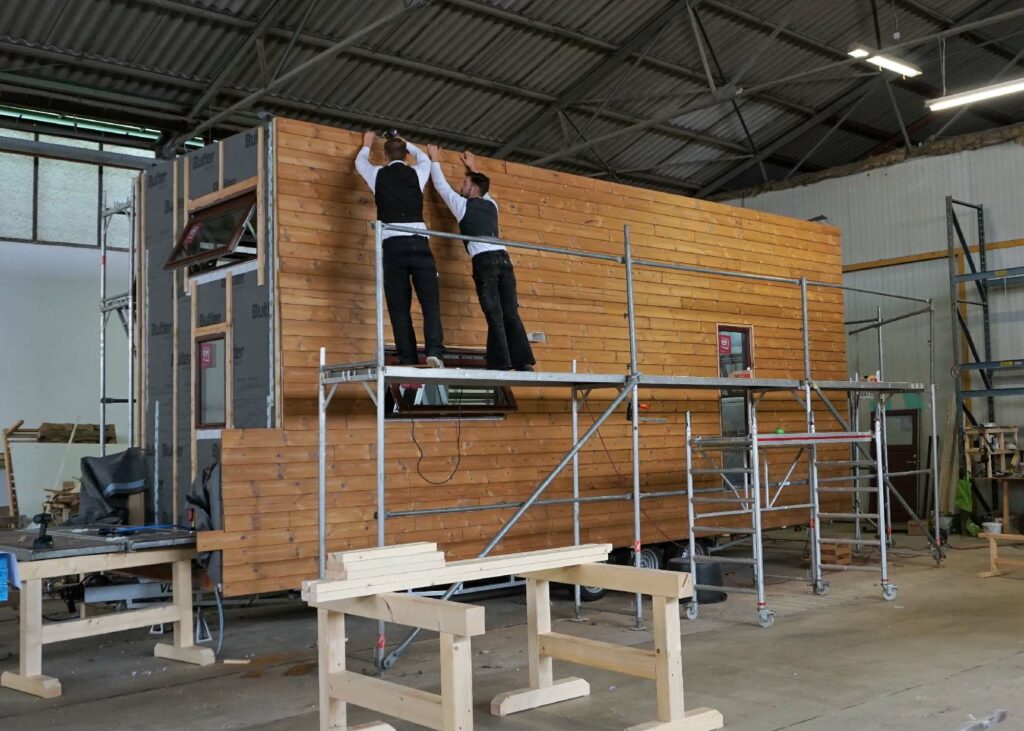
There are a number of materials available for façades, yet on Tiny Houses you mainly see timber façades. Why is that? Stone and brick façades are simply far too heavy for a mobile house, and plastic façades are unconvincing in terms of sustainability. Timber, by contrast, is a natural, renewable raw material that has been used in construction for centuries. If native timbers are used, a timber façade is therefore very sustainable. With the right care, timber façades are also very long-lasting. And of course they simply look very attractive. Some types of metal, however, can be used just as well, both in terms of weight and with regard to their other properties. Standing-seam and trapezoidal sheet metal, for example, are options here. In combination with a timber façade in particular, they can set attractive accents.
The façade essentially determines the appearance of the Tiny House. Where is it going to be sited? What suits me and the landscape visually? Whether painted in colour or left natural, there are hardly any limits.
The façade is the part of the Tiny House that is relatively unprotected from the weather. When choosing a façade you should therefore pay particular attention to weather resistance. Weather resistance is essentially about how readily the material absorbs water. Once timber is saturated with water, conditions are good for fungal attack, and sooner or later the façade starts to go mouldy or rot.
If you want to leave the façade untreated in particular, you should opt for durable timbers. But the timber can also be protected against water ingress by a surface treatment. That way, less durable timbers can be made usable for the façade as well.
With the right treatment, such as an opaque coating, softwood can nevertheless be used. Some softwoods, such as larch, are very suitable even so, because weathering gives them a natural protection that makes the timber resistant to biological ageing processes. The timber does turn grey in the process, however, and depending on the weather and the orientation, various shades can develop, from silver-grey through brown tones to black. In return, a further surface treatment can be dispensed with.
Hardwoods such as robinia or oak have fundamentally good properties for façade construction, as their timber is very dense and therefore more durable. However, they are also much heavier than softwoods and considerably more expensive.
One important decision is the question: Should the façade be treated or not? The timber surface can be protected in a variety of ways. A surface treatment can also be purely decorative. Clear varnish, pigmented varnish – so that the natural grain still shows through – or opaque colour in any shade desired. That is purely a matter of taste. Colour pigments can be applied as well, so that brown, green or grey timber tones are created. For better protection, the façade can additionally be treated with oil.
Thermally modified timber, also known as thermowood, is made far more durable through the use of high temperatures. It is very stable and long-lasting and needs hardly any maintenance. Fungal attack can still occur, but the timber is not damaged by it; it is merely a visual impairment.
One of the most important aspects of a façade is durability. After all, you want to enjoy your Tiny House for as long as possible, without elaborate and costly refurbishment becoming necessary after only a few years. One of the greatest enemies of a timber façade is wet, so in rainy regions in particular you have to make sure that no water can penetrate the façade. Particular attention should be paid to the vulnerable end grain and to the water edges.
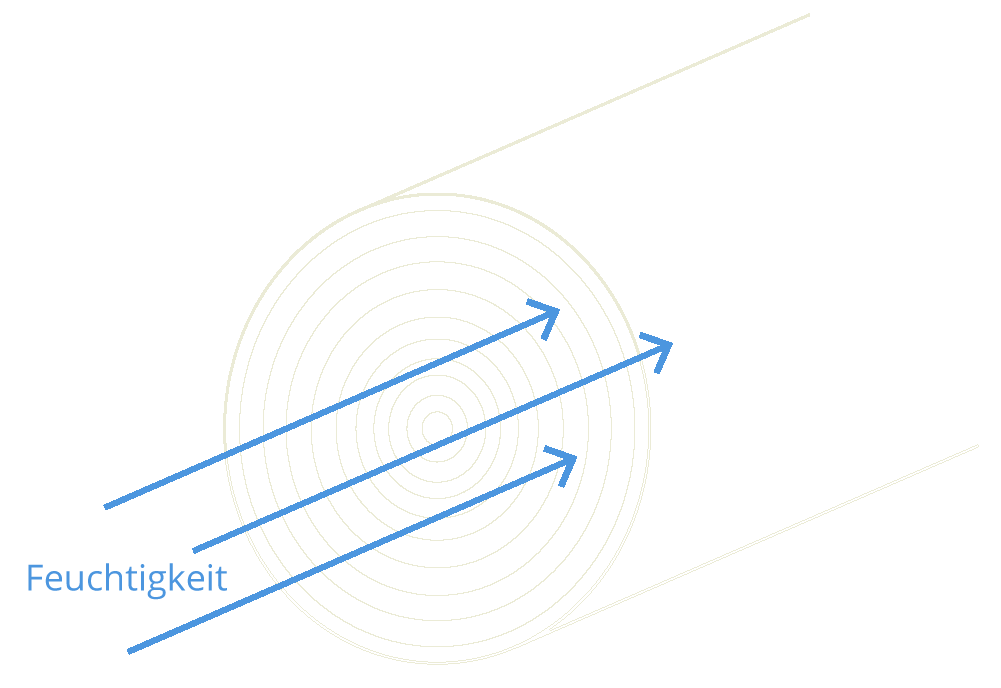
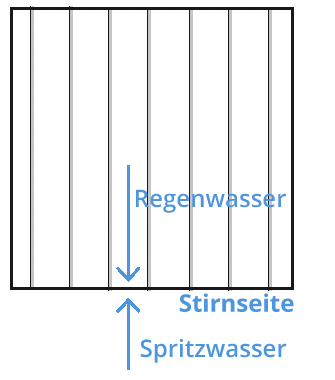
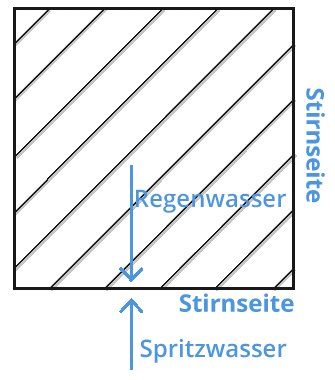
At the end grain of the timber the wood fibres are cut through, and capillary action makes them soak up water like a sponge. If these parts of the façade are left untreated and permanently exposed to moisture, the timber becomes damp and starts to rot.
The end grain can be protected against wet by a coating or a splash guard, or indeed by a type of façade in which hardly any end grain is left exposed.
Water edges are areas where rainwater can collect over a longer period, such as ledges and joints. They are particularly vulnerable to penetrating moisture.
Splash water bouncing back up off the ground can be a problem too. The distance from the ground therefore plays a role as well. A splash guard, made of metal for example, can protect the vulnerable lower edge of the façade.
A high-quality façade is rear-ventilated. This means there is a gap between the façade and the insulation, so that the air behind the façade can circulate. This allows the façade to dry out properly at all times and prevents trapped moisture from forming.
Wet in the façade causes the material to swell, the façade warps and it also provides ideal conditions for fungal attack, mould and rot. Infestation by animals can likewise be a consequence of a façade without rear ventilation.
See also: Moisture: Rear-ventilating the façade | Insulation
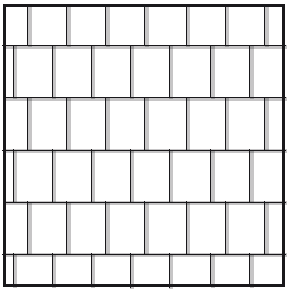
With horizontal cladding you avoid the problem of exposed end grain, because the end grain is protected by the way the boards are laid. On the other hand, the water cannot run off as easily and every single board has a water edge, which generally increases the moisture load. It is best to angle the façade from top to bottom (as with feather-edge cladding), so that the water can run off. It is also practical that, in the event of damage, individual boards can be replaced without having to renew the whole façade.
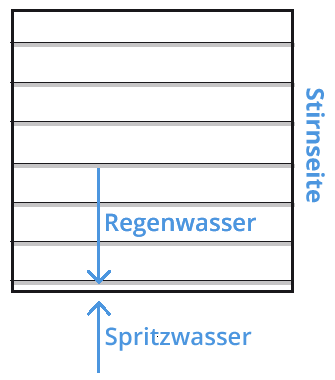
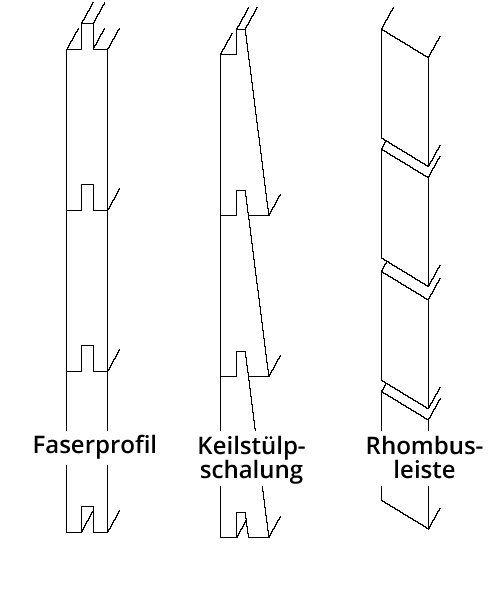
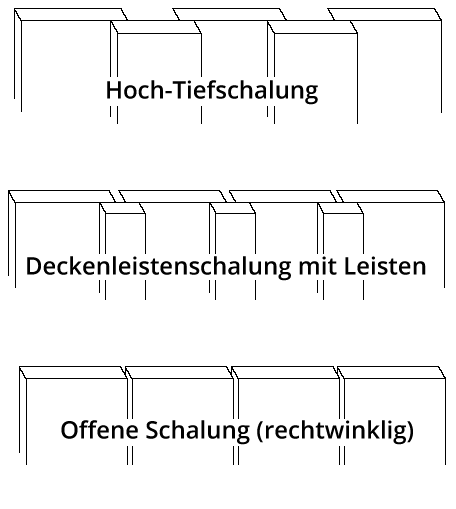
With vertical cladding the water can run off well and there is only one water edge. However, the vulnerable end grain is at the bottom, in the splash zone near the ground, and is therefore more exposed to moisture. With vertical cladding you must therefore make sure that enough distance from the ground is maintained at the bottom, or fit a splash guard.

Worth knowing: Tips for construction & care | Insulation