Price list
| Campervan consulting | €90/h |
| Tiny house consulting | €90/h |
| Business and start-up consulting | individually on request |
| Initial consultation | 30 min, donation-based |
| Hands-on work, per hour | on request |
| Travel to and from site | by arrangement |

A Tiny House is a proper house too, and houses need care. On every house there will be something to put right at some point; perhaps the façade or a window will need repainting. With mobile houses in particular, something can warp as a result of transport or longer periods standing still. In the first few months especially, timber houses settle, there is creaking here and there, and doors and windows may need readjusting.
There is plenty you can pay attention to during the build, though, so that your dream house lasts a long time. And in the finished small home, a few care tips should be observed as well. Then the house should stay with you for a lifetime.
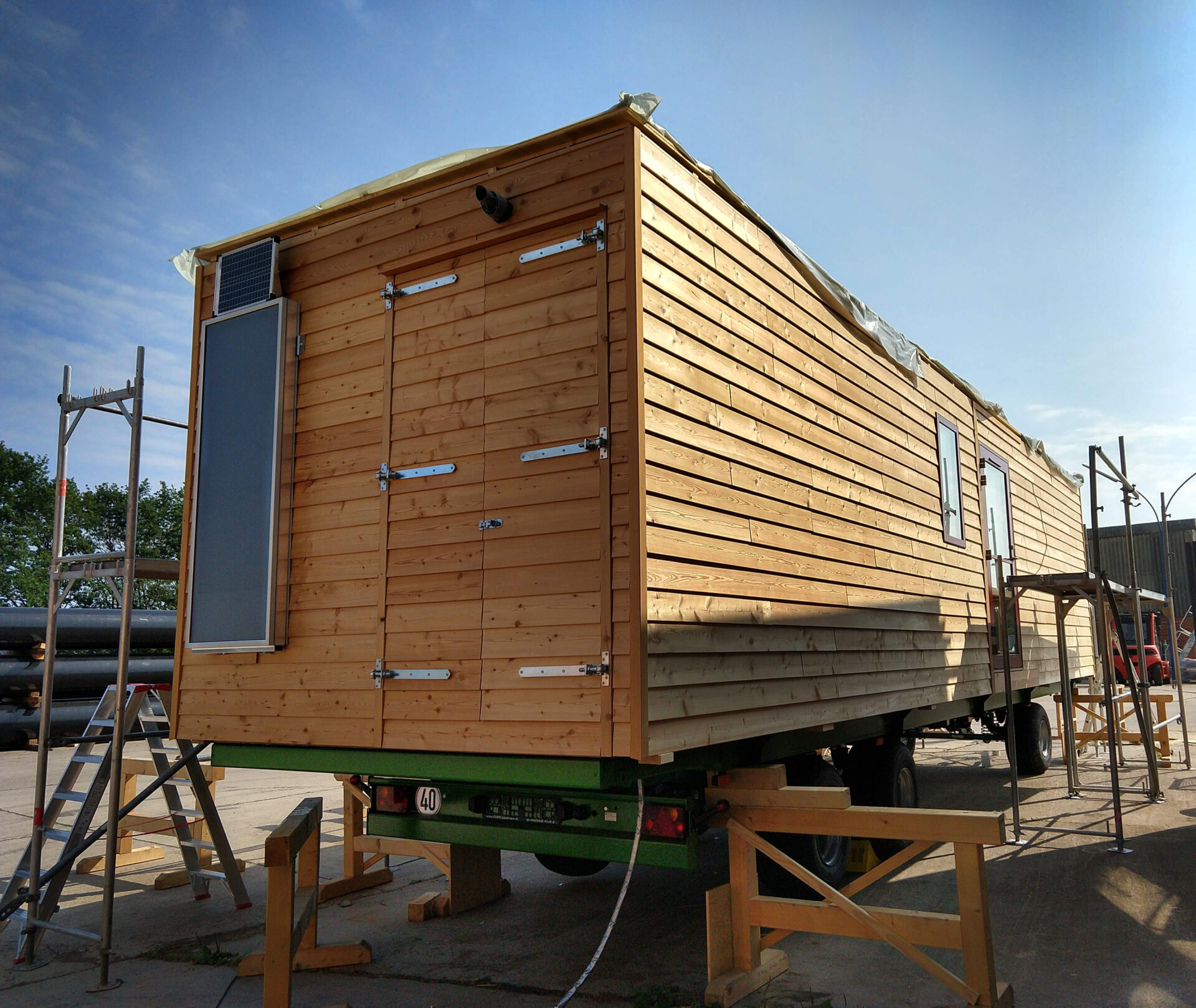
Moisture is one of the biggest risk factors for the service life of a Tiny House. A Tiny House is a small space in which people live, breathe, sweat, cook and shower.
So there are many sources bringing moisture into the space. And Moisture is unfortunately the ideal precondition for mould growth. There are, however, several measures that can be taken to prevent it.
Because this topic is so centrally important, I have devoted a separate topic page “Moisture in the Tiny House” to it. It covers the subjects of Water vapour, Vapour-permeable construction, the sd-value, I explain the function of Vapour barriers, explain Thermal bridges and Effective insulation and give guidance on Avoiding moisture .
Experience has shown that it is not necessarily essential to rear ventilate the façade; ventilation and an exchange of air through the joints can also be enough to prevent excessive moisture in the façade. What is important, however, is that there is a layer of air behind the façade. Without this layer of air, water that gets behind the façade, for example through driving rain, cannot drain away properly, trapped moisture can build up and mould can form. The layer of air behind the façade also serves summer heat protection and helps to avoid a build-up of heat between the insulation and the façade.
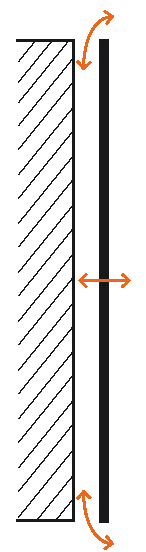
rear-ventilated façade
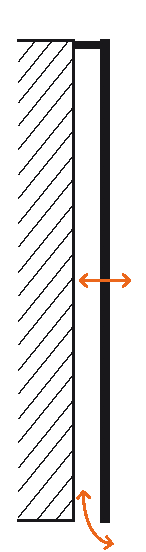
ventilated façade
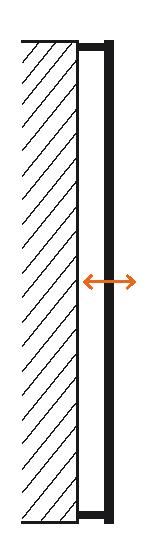
façade without rear ventilation, with a layer of air
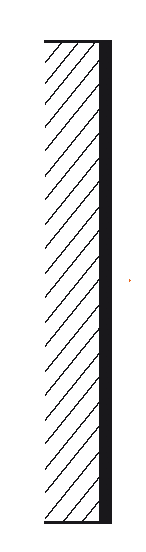
façade without rear ventilation, without a layer of air
Depending on exactly how the façade is fixed, it is described as rear ventilated, ventilated, or not rear ventilated with a static layer of air. With rear ventilation, an exchange of air takes place through openings at the top and at the bottom; with ventilation, the air can only be exchanged through an opening at the bottom. A façade without rear ventilation but with a layer of air should have a high proportion of joints, so that air can be exchanged through the joints. This kind of air exchange is also present with ventilated and rear-ventilated façades. In principle the façade can also be fitted without a layer of air; it is then described as a façade without rear ventilation and without a static layer of air. In that case, however, no exchange of air can take place at all, and trapped moisture can no longer dry off properly.
Related to this topic: The topic page “Façade”
No matter how well a house is built and insulated, it must always be ventilated properly. Smaller rooms in particular need a regular exchange of air. Over the course of the day, the air in a closed room becomes enriched with all kinds of substances; we perceive it as “stale”. A large proportion of this is CO2, which is produced by breathing. A raised CO2 level in the air reduces our performance and makes us tired.
At the same time, moisture collects in the air through washing, cooking, breathing and the perspiration of the people in the room. Animals and plants release moisture into the air as well. On top of that come smells from cooking or from the toilet, as well as off-gassing from new pieces of furniture. But to live and breathe we need oxygen, so the air has to be exchanged regularly. If too much moisture collects in the air, the risk of mould forming on the walls also increases, because fungi prefer a damp climate. Correct ventilation is therefore essential.
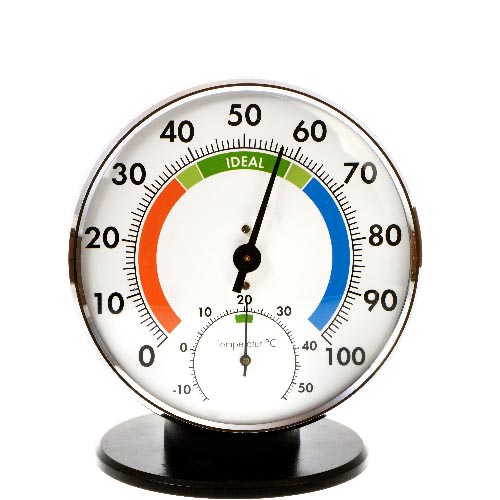
An ideal indoor climate is achieved at a relative humidity of between 30 % and 60 %. Below that, dust smoulders on heating surfaces, which can release irritant substances such as ammonia. Above 60% humidity the air is perceived as unpleasant, because the body’s heat regulation no longer works properly. Relative humidity can be influenced easily and effectively, above all by ventilating. If a relative humidity of over 70 % occurs close to the wall surface, this encourages mould growth, even if no condensation is yet visible on the wall.
Directly at the wall surface, a low wall temperature can mean that the relative humidity is considerably higher than the humidity in the middle of the room. How often and when you need to ventilate depends above all on the moisture loads in the room. If you want to know exactly, you can install a hygrometer. At a humidity above 65 % you should ventilate. Because objects can also absorb moisture from the room and release it back into the air, the air can reach a raised moisture content again relatively soon after ventilating.
The most obvious way to ventilate is of course windows. There should be enough of them, ideally also in places where a lot of moisture is produced, such as in the bathroom or above the cooker. When arranging the windows, care can be taken to allow a good through-draught. This is achieved with windows opposite one another, and roof windows can play their part too. Many windows, roof windows in particular, also have a ventilation setting that allows at least some exchange with the outside air.
If you need support with building or maintenance: Trade services are something I also carry out on site.
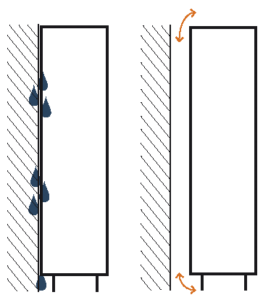
To avoid mould it is important that the exchange of air in the room can take place properly and that humid air is replaced by dry air. This requires a certain amount of air circulation in the room. At edges and in corners in particular, air circulation is restricted, which reinforces the local drop in the room-side surface temperature at thermal bridges. Furnishings such as cupboards disrupt the thermal flow of the air and restrict the radiation exchange with the surroundings. As a result, the air at cool surfaces behind cupboards may not be carried away or able to warm up. Because the water vapour content of the air depends on temperature, condensation and therefore mould are more likely to occur here. Cupboards should therefore never stand flush against the wall; a small gap should be left for air circulation. The same applies to the contents of shelves fitted directly to the wall.
Ideal temperatures:
Living area 20–22 °C
Bedroom 17–18 °C
& kitchen
Minimum temperature 15 °C
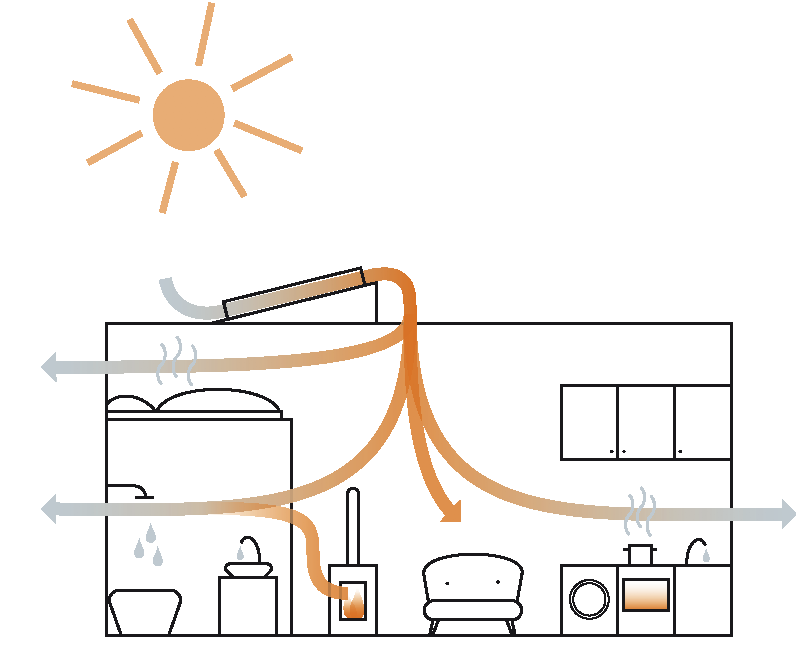
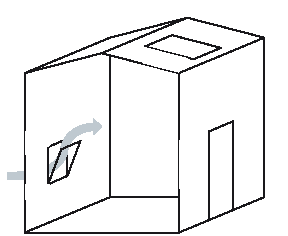
Winter 30–75 minutes
Spring/autumn 1–3 hours
Summer 3–6 hours
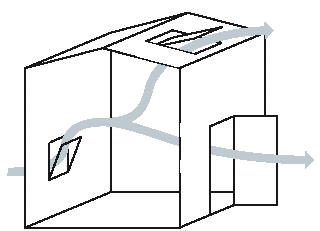
Winter 4–6 minutes
Spring / autumn 8–15 minutes
Summer 25–30 minutes
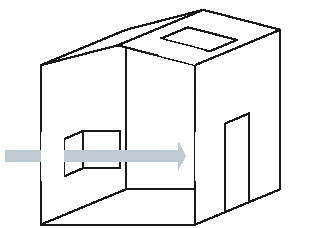
Winter 4–6 minutes
Spring / autumn 8–15 minutes
Summer 25–30 minutes
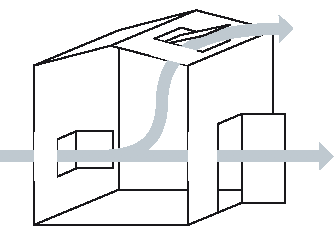
Winter 2–4 minutes
Spring / autumn 4–10 minutes
Summer 12–20 minutes
Related to this topic: topic page “Moisture in the Tiny House”
A Tiny House should also be seen as a fully-fledged house, and every house needs repairs at some point. It would not occur to anyone to live in a detached house for decades without ever carrying out a single repair. Even though a Tiny House is smaller, it needs care.
For example, you should check at regular intervals whether the water can still drain properly from the roof and clean any blocked filters leading to the gutter. After a few years, work on the roof covering may also become necessary. The Facade is likewise worth keeping an eye on. If it is heavily soiled, for example by splash water after heavy rain or perhaps by bird droppings, the affected areas should be cleaned with a brush. Damaged façade boards should be replaced. And if the façade is painted, then the paint must be renewed regularly as well.
Naturally, high-quality materials that last a long time should be used from the outset. But the service life of the whole house can be increased considerably through care and prompt repairs, should something break.