Price list
| Campervan consulting | €90/h |
| Tiny house consulting | €90/h |
| Business and start-up consulting | individually on request |
| Initial consultation | 30 min, donation-based |
| Hands-on work, per hour | on request |
| Travel to and from site | by arrangement |

Living as far off-grid as possible in your own Tiny House, that is independently of others, is a tempting idea for many people. Usually the aim is to be independent of the usual supply networks, meaning municipal energy and heat supply (energy self-sufficiency) and water (water self-sufficiency). In Germany, however, this is not at all easy to put into practice and in everyday life it is often more of a burden than you might expect. Achieving a certain degree of partial self-sufficiency in a Tiny House is nevertheless perfectly possible and, from a sustainability point of view, makes good sense.
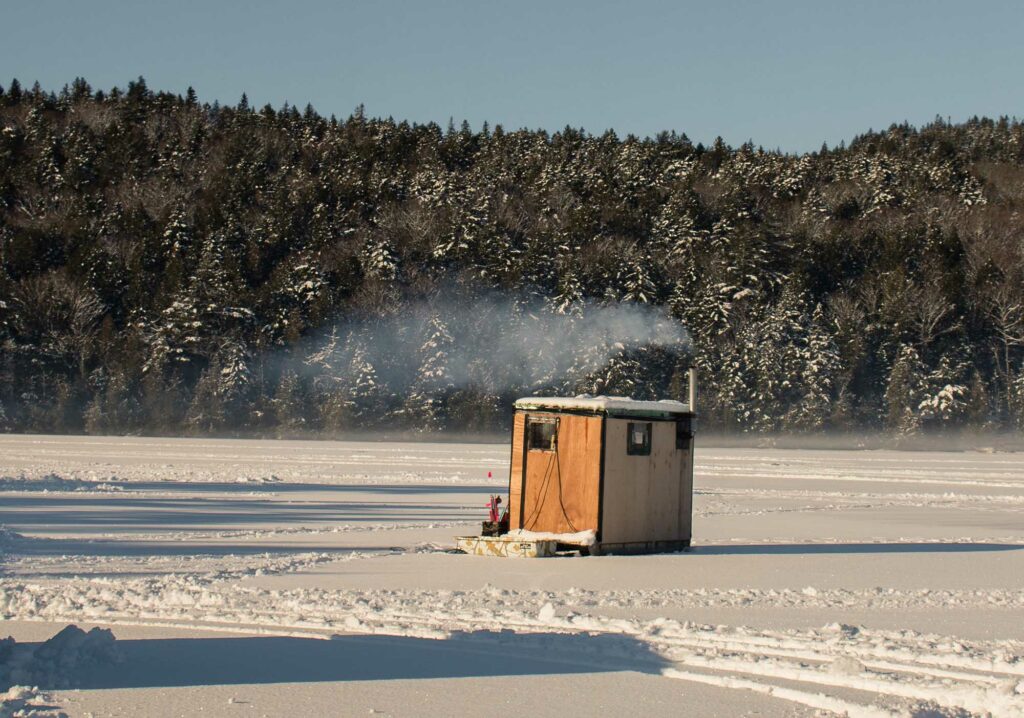
Strictly speaking, being off-grid would mean complete independence from others in every area of life. That would mean not only supplying yourself with food, clothing, water and energy, but also making all the tools you need for that yourself. Having a connection to a road, to the telecommunications network or a letterbox can also be seen as a link to the supply network. In everyday usage, however, these aspects are usually not taken into account.
How far off-grid living makes sense in your case, and at what point the effort outweighs the benefit, is something I work out in the Off-grid consulting for your project.
Partial self-sufficiency can mean either that a house is only energy self-sufficient, for example, but not water self-sufficient. It can also mean that part of the electricity is generated on site but there is still a grid connection in case the electricity produced and stored is not enough. A grid connection is generally sensible for a Tiny House. Despite effective storage solutions, there may be times when not enough energy is available, and even the best system can fail or break down. That usually also means no heating and no hot water, which quickly becomes a problem, especially in winter.
Before deciding on a solar power system, you should analyse your own electricity consumption. How much electricity do you actually use? At what times of day do you need the most? Do you perhaps need considerably more electricity in winter because you want to heat electrically? In general it can be said that a self-sufficiency level of 70 % is readily achievable with the right modules and storage sized to match consumption. The percentage refers to the year as a whole: in summer you may be 100 % self-sufficient throughout, while in winter you may only reach a self-sufficiency level of 2 % on bad days. Even with the roof area of a detached house, it is assumed that at our latitudes you will depend on another source of electricity in winter.
To supply a house with solar electricity, a photovoltaic system is needed. It consists of several components. First of all, of course, the solar modules, which convert light into electricity. They have to be fixed to the roof using a suitable mounting system. To plan this, it is important to know where the house will later stand, because the mounting system has to be designed for the wind and snow loads that occur in the region. Solar modules also produce direct current, whereas normal household appliances run on alternating current. An inverter is therefore needed to convert the direct current into alternating current and so make it usable.
If you want to use all or most of the electricity yourself, you will also need storage to hold surplus electricity produced at peak times. For this, usually lead-acid batteries or lithium-ion batteries are used. Computer-assisted systems are available for efficient control.
The scope for generating solar electricity is limited by the area available. In a Tiny House this is of course smaller than on a detached house. That means anyone relying on solar energy in a Tiny House should plan carefully.
The efficiency of a solar system depends primarily on the solar modules used and on their orientation and tilt. Above all, the house should not stand in a shady spot, for example between trees or in the shadow of a larger building. The pitch of the roof also affects how efficiently the solar panels generate electricity. A flat roof is less suitable, because the modules cannot receive full sunlight all day. Best is a pitched roof facing south, east or west. The solar modules on a roof can also face in different directions, for example east and west. That way enough electricity can be produced in the morning and in the evening – the times when most energy is usually consumed. If all three sunny compass directions can be covered, you are best supplied. Even on a flat roof, solar panels can be aligned to particular compass directions if they are mounted at an angle.
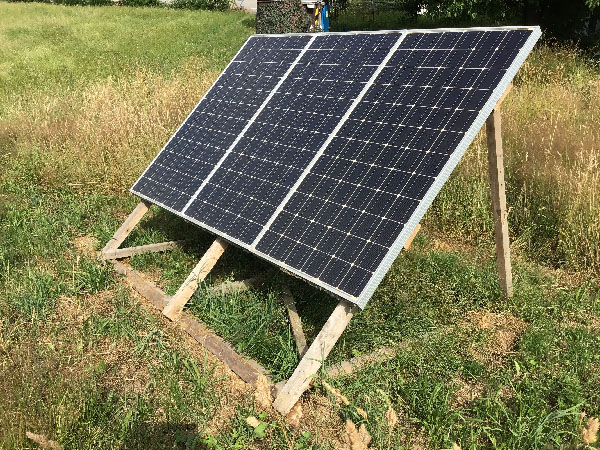
These solar cells are made of silicon; they have a crystalline structure and an even surface with a bluish to black sheen. Among crystalline solar cells, a distinction is made between monocrystalline and polycrystalline cells:
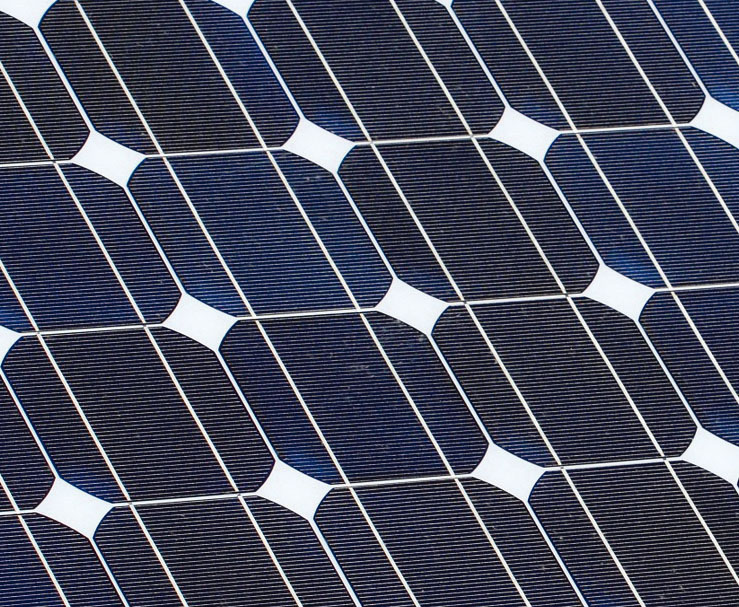
Each cell consists of a single crystal. These crystals are specially grown, which makes production relatively expensive. In return, at 14–20% they have a higher efficiency than polycrystalline solar cells (12–16%) and also perform better in low light. The individual cells are squares with rounded corners, mounted on a usually white backing film. This creates a black-and-white tiled look.
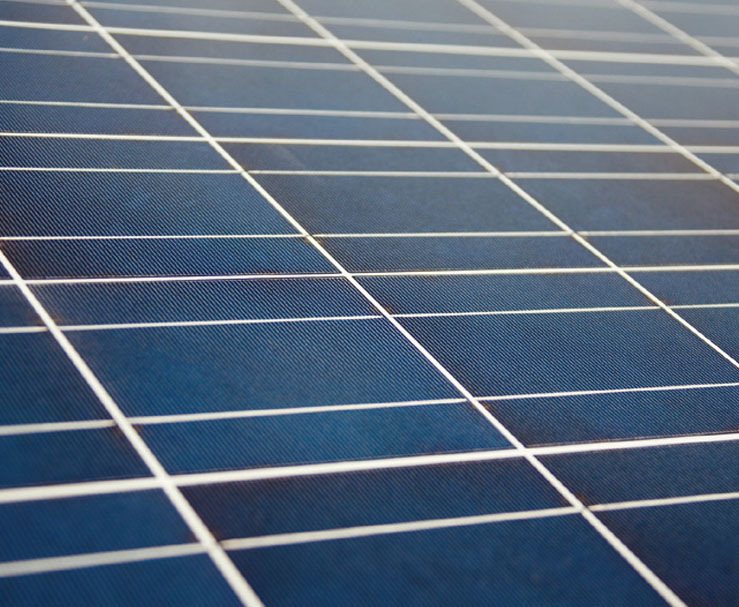
They consist of several silicon crystals – you can make out the individual crystals in the cell structure. Production is cheaper: natural silicon is melted, then poured into a mould and cooled. The individual solar cells are therefore rectangular and can be arranged so that a continuous surface is created.
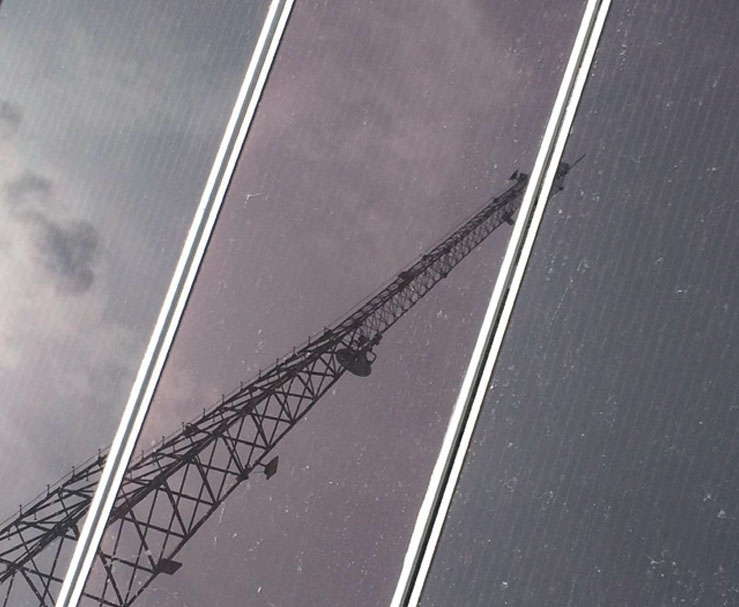
In the production of thin-film modules, a semiconductor material is vapour-deposited directly onto a carrier material such as glass, metal or plastic. The layer is only a few micrometres thick and can also be applied to flexible materials, so the modules are very light and thin and production uses fewer raw materials.
However, they are less durable than crystalline solar cells and also have a much lower efficiency (6–10 %). They are therefore not well suited when only a small area is available for a solar system. On the other hand, they lose only a little output at very high temperatures or in weak and diffuse light conditions.
These modules are based in principle on the same technology as thin-film modules. However, they are not flat but have a tubular absorber, which lets them take in direct and indirect sunlight from all sides. That makes them particularly effective in the morning and evening and improves their suitability for flat roofs.
Their efficiency is average (13–15 %), but they can make better use of low light intensity and diffuse light than thin-film or crystalline modules. That makes them interesting above all for use in winter.
CIGS modules are still relatively new, so there are no long-term findings yet, and they are also very expensive to buy.
If a grid connection is possible, you should make use of that option. Even the best system can fail, or there may be times when not enough electricity is produced to cover all needs. That is most likely in winter, and that is exactly when it can become a problem, particularly if you also heat or warm your water with electricity.
Most PV systems in Germany are installed so that the electricity generated can be fed into the grid and, when no electricity is being produced, at night for example, electricity can also be drawn from the grid. You receive money from the provider for every kilowatt hour fed in. For a Tiny House this is of little relevance, since the small area will probably produce only a small surplus. Besides, it is always cheaper to use the electricity yourself than to feed it in.
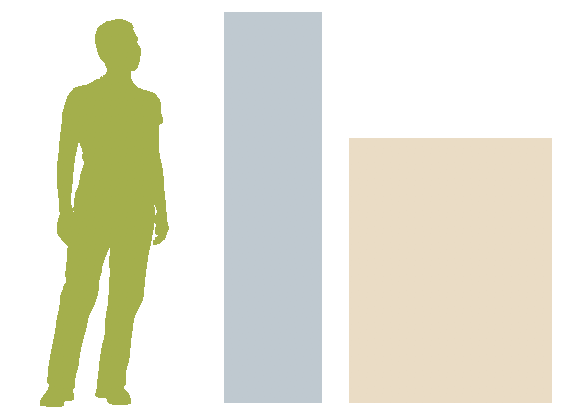
Shorter periods without sunshine can be bridged well with storage systems. The longer the periods without sun last, the larger the storage naturally has to be.
How large the storage has to be depends on your own electricity consumption and on the level of self-sufficiency you want. The more electricity you want to use yourself, the larger the storage has to be. A large storage unit, however, needs more space, and efficient batteries are not exactly cheap.
Depending on the manufacturer, storage units are usually 1.3–1.9m high and 0.5–1m deep.
A big influence also comes from the output of the PV system, because a large storage unit is only of use if it can actually be filled during the hours of sunshine.
It indicates how much of the stored energy can be made usable again. The storage therefore also has a substantial influence on the efficiency of the system as a whole. The efficiency of modern lithium-ion batteries, however, is 95–100 %.
This is the maximum energy that can be stored in one charge. Typical values are between 6–16 kWh. More important, though, is the usable capacity, which indicates how much of the stored energy can be used if the specified depth of discharge is observed.
Their number indicates how often the storage unit can be charged and discharged again when the full storage capacity is used. Values of 5000 cycles or higher should be possible.
They have been in use for a very long time and are best known as car batteries. Special lead-gel batteries have been developed for storing solar electricity, and they are more resistant to wear than conventional lead-acid batteries. Even so, at 5–15 years and around 3000 charging cycles they have a fairly short service life, and at 65–85 % their efficiency is also below that of lithium-ion batteries. They also have long charging times and are very heavy. On the other hand, they are cheaper to buy, robust and reliable and can be recycled well and easily.
One key advantage is the relatively low weight of these batteries. They also have a very high efficiency of 85–98 %, which makes them far more capable than lead-acid batteries. They have a longer service life of about 20 years (> 5000 charging cycles) and wear less during charging and discharging. Lithium iron phosphate batteries are particularly safe, as they cannot burn or explode and are non-toxic. A disadvantage is that lithium-ion batteries are sensitive to overcharging and deep discharge, and that lithium is a rare raw material and therefore not very sustainable. On top of that, they are difficult to recycle.
Also of interest: Heating | Insulation
Traditionally you get your (drinking) water from the municipal water supply. On building plots in Germany, connection to the water and sewage network is a legal requirement (§3 AVBWasserV). Being self-sufficient in this area is therefore hard to achieve legally at present. There is of course still the option of collecting rainwater and using it as service water, which saves a lot of water. Water from a well can in principle also be used as an additional source.
In Germany, rainwater may be used for watering the garden, flushing the toilet and doing the laundry, that is wherever drinking water quality is not required. If enough of it can be collected, this saves a lot of water. If rainwater is to be used in the household, however, two separate pipe systems have to be installed, and they must also be colour-coded. Rainwater draw-off points must additionally be secured against unintentional or unauthorised use, for example with lockable valve tops.
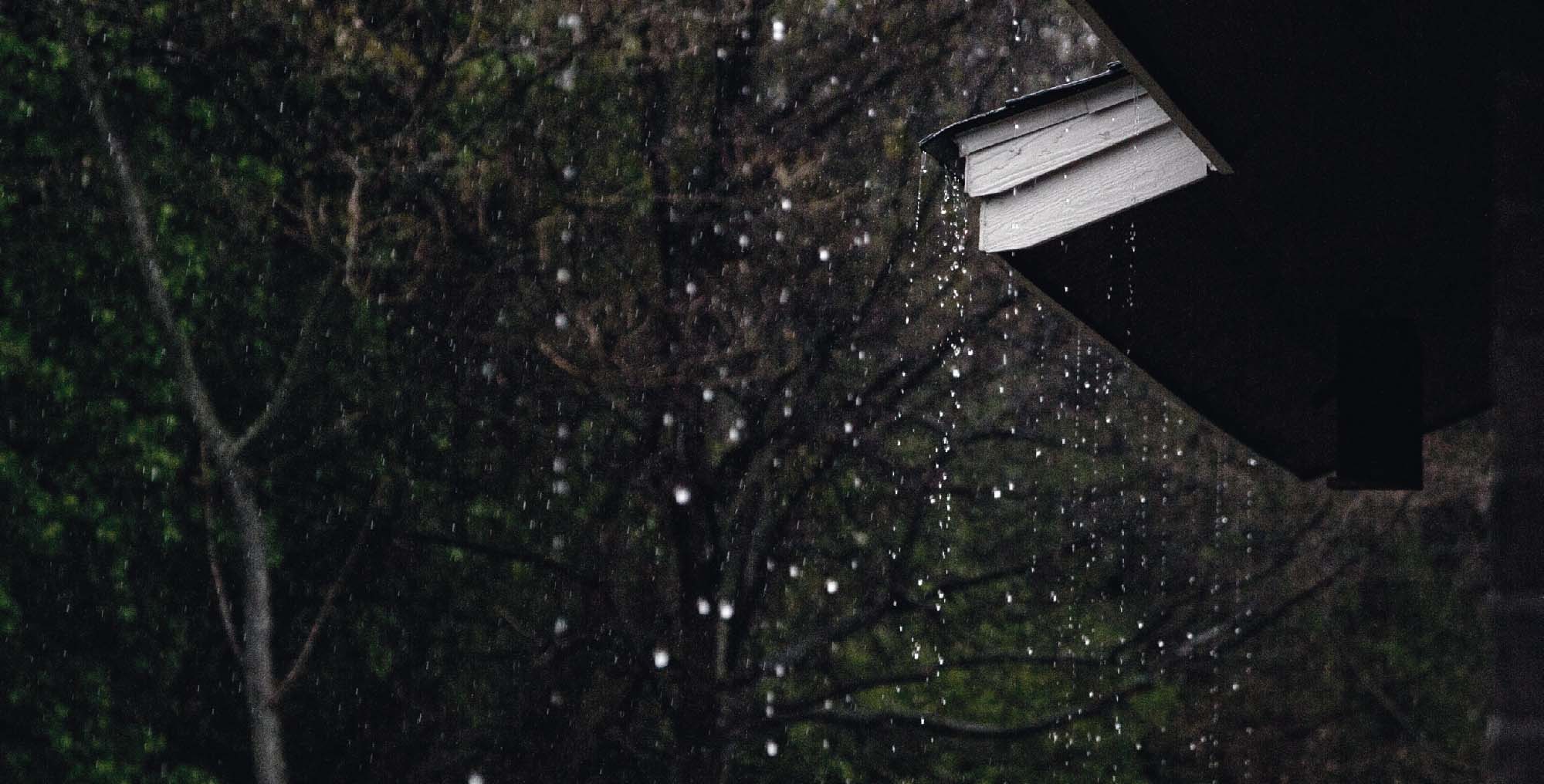
Rainwater can be collected in a wide variety of ways. The simplest and cheapest solution is a water butt placed under the downpipe of the gutter. For watering the garden that can be entirely sufficient.
If you want to collect larger amounts for the household, cisterns in the ground are a good option. They take up no space in the garden and the water is protected from heat and UV light, which prevents germs from forming and the water from going stagnant. Cisterns are usually connected directly to the rainwater downpipe. A filter is fitted upstream to remove dirt from the water.
Water is drawn off with an electric submersible pump or through a pipe system leading directly into the house. If a rainwater circuit is installed in the house, the cistern must have a drinking water inlet so that the supply to the toilet or the washing machine is guaranteed even in periods with little rain. Surplus rainwater is usually discharged into the sewer via an overflow in the cistern.
Rainwater from a correctly installed rainwater harvesting system with a cistern does not need to be filtered separately before being used for the garden, for flushing the toilet and for doing the laundry. Experience and studies have shown that these applications are entirely safe.
Depending on whether you want to live in your Tiny House permanently or use it primarily as a garden house, you are bound by different rules. In a garden house, for example, no water connection is required.
If the house has no water connection, because it is only used as a weekend house for example, you can also install drinking water tanks inside the house. You should estimate your water consumption carefully beforehand, so that the tanks can be sized accordingly and enough space can be allowed for in the house. Installing tanks underground is also possible; that saves space in the house and keeps the water cool in summer.
Water tanks are usually made of polyethylene or stainless steel. Both are harmless and no substances are released into the water. The water tanks have to be refilled regularly, for example from a nearby connection or by hand. The water should not stand in the tanks for too long, as germs can build up. After a longer period of non-use, the tanks should therefore be cleaned.
If the water is to be used as drinking water, it is also worth considering a filter system as an addition. Which filter makes sense depends on the type of contamination and on the intended use of the water.
In Germany you are generally obliged to connect your house to the public sewer system, in order to dispose of the waste water produced properly. In rural areas it can happen that such a connection is not possible. In exceptional cases the waste water can then be treated in a small sewage treatment plant requiring approval, for example in the form of a treatment pond, and afterwards allowed to seep away.
If the house has no sewage connection for other reasons, the waste water can be collected in small tanks and released into the sewage system at a suitable point. That is a good option in allotment gardens, for example, since by law these have to be managed without waste water. In domestic use, it is above all surfactants and soaps from washing up that pose a danger to the environment. So if you do have to wash up out in nature, you should do without washing-up liquid or use special environmentally friendly products.
You might also be interested in: Tips for construction & care | Moisture