Price list
| Campervan consulting | €90/h |
| Tiny house consulting | €90/h |
| Business and start-up consulting | individually on request |
| Initial consultation | 30 min, donation-based |
| Hands-on work, per hour | on request |
| Travel to and from site | by arrangement |

Every tiny house also needs a place where it can stand. Depending on what it is intended for, that place can look very different. The location should be part of the planning from the outset, because not everything is possible everywhere. Different pitches come into question depending on how the house is used – or the other way round: sometimes the preferred location has a decisive influence on the design and use of the house.
Whether your preferred location allows for that is often decided by the details of the local Bauordnung (building regulations). In the Tiny House consulting I look at your specific case before you commit to a plot of land.
What matters most is whether the tiny house is to be lived in as a primary residence or as a holiday home, because that affects both the choice of location and the type of plot:
If you want to live in your small house permanently, it is of central importance that this is also legally possible at the location you have in mind. The main options are building plots, which can either be bought or leased. Some campsites also permit permanent residence. Depending on what you decide on, there are various rules to observe during construction. On a building plot, for example, a Bauantrag (building application) has to be submitted, and you have to comply with requirements such as the obligation to connect to the mains water supply.
Different rules apply to use during the holidays than to permanent residence. The question of registering your address does not arise here, because a primary residence already exists. In addition, you can buy or lease plots that have not been released as ordinary building land but are designated as Wochenendhausgebiete (weekend-home areas). In these areas, however, different standards often apply to infrastructure, facilities and connections to the utility networks.
If you want to live in one place permanently, you can buy a plot of land, for example. It is important to make sure that it is advertised as building land. In that case you can build in the ordinary way or place a tiny house on the plot. The formalities here are similar to those for a large house, though: you need a Bauantrag (building application), which also includes proof of structural calculations. That requires the expertise of architects and structural engineers.
The necessary connections for electricity, water and waste water should normally already be available on building land, or in exceptional cases they have to be added. Further development costs may arise here.
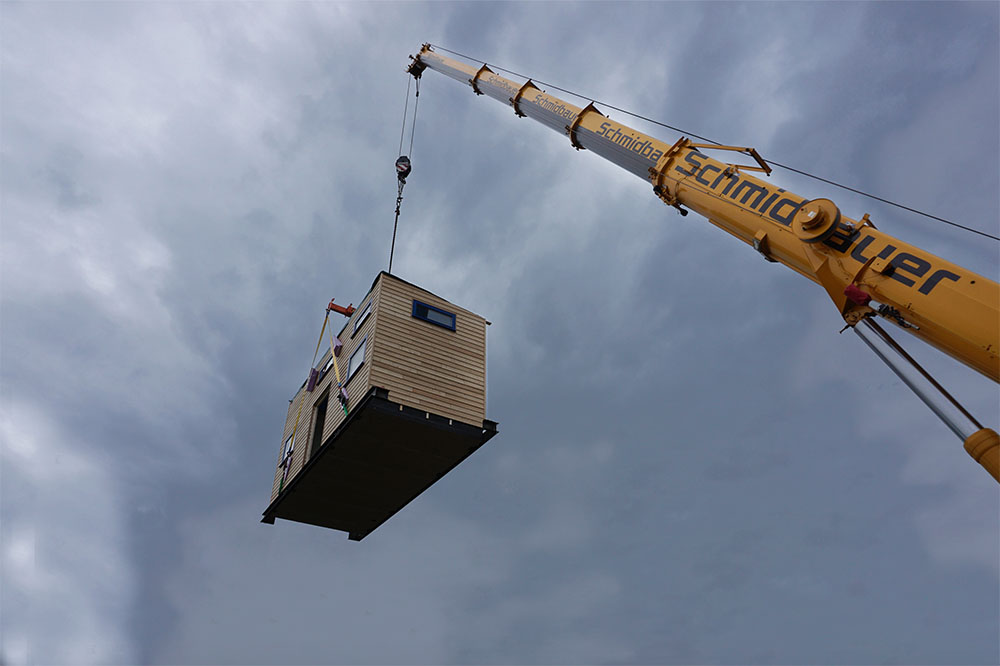
Instead of buying a plot, you can also lease one. Here, too, it is important that the plot has been released as building land. As a rule, the same regulations apply to construction as on a plot you have bought. The landowner may also set additional rules of their own for the plot. You should also make sure that the house remains mobile, because many plots can only be leased for a few years. A crane-lifted house is still an option, but you should do without parts that require elaborate assembly on site.
If you have a large garden, you have the option of putting your tiny house there. If you intend to live in it, you will need a Bauantrag (building application) for this too and will have to comply with the local authority’s Bebauungsplan (local development plan). But even if the house is only going to be used as a summerhouse, an office or a guest room, an application usually has to be submitted first. Ancillary structures such as summerhouses may likewise only be erected within the permitted building lines, and minimum distances from neighbouring plots have to be observed. Only smaller buildings (10 sqm, or 30–75 cubic metres depending on the Bundesland) without a habitable room, toilet or combustion appliance are exempt from permission. That is unlikely to apply to most tiny houses. The wheels do not necessarily help either. German building law does distinguish between fixed buildings and mobile temporary structures, but a Bauwagen (site cabin) that is set up permanently, for example, does require planning permission. Things look somewhat different if the house holds a caravan registration.
Since these settlements also have to comply with German building law, it will still not be possible to do without a water connection, for example.
There are no rules that apply to tiny houses across the board. What has to be observed when erecting a building varies from region to region and from one local authority to the next. You will find the details in the local Bebauungsplan (development plan). If there is none, the general building laws have to be complied with and the new building must fit in well with its immediate
surroundings. Each new structure is then assessed individually, and consideration has to be given to neighbours and adjoining owners. Some local authorities also have clear ideas about what the roof covering, for instance, should look like. It is therefore worth finding out about the local rules ideally before buying a plot, in order to establish whether they are compatible with your own plans.
The ground on which the tiny house is to stand must absolutely be level , because on a slope the house will stand at an angle too. Living in a house that is out of level is not only impractical, it is also bad for the structure.
The rule is: the more level the ground, the better. On firm, load-bearing ground such as asphalt or compacted gravel, the house can simply be set down. Looser garden soil, meadow or farmland does not offer enough support – over time the house will sink in and be damaged. Small houses therefore usually need foundations as well. They do not have to be as large as those for a normal house, but they still have to carry the weight of the house. In most cases, concrete pad or strip foundations, or else ground screws, are sufficient. These can even be removed completely after a move.
The foundations have to be produced by a civil engineering or landscape gardening contractor and this is not included in my services. I am glad to help you with all technical questions, though, and will specify the exact size and position of the foundations.
What is decisive for financing is whether a tiny house
stands mobile on a trailer or can be classified as real property. If the house is to be financed by a bank, owning your own plot definitely has advantages. In that case what is being financed is a property, and that is often possible on better terms than financing a mobile house. For that, however, the plot has to belong to you; if it is only leased, property financing is not possible.
For the house to be financed as a property, it must also stand permanently on the plot and be anchored to the ground. That is the case with a crane-lifted house on pad foundations. In principle, the anchorings can still be released again and the house moved. It is somewhat more involved, though, and should not be planned as a regular occurrence.
For a mobile house, usually only a Kfz–Finanzierung (vehicle loan) is possible, the house is regarded as a “Mobilie” (movable asset), similar to a caravan.
You might also be interested in: Trailer & Transport | Tips for construction & care